
Contents
- 1 Quick Answer
- 2 Introduction
- 3 Leading AI Copywriting Tools and AI Assistants in 2026
- 4 AI vs human copywriters, Who is better?
- 5 AI vs Human Copywriters: Understanding Conversion-Focused Copywriting
- 6 What Are AI Copywriting Tools?
- 7 AI vs Human Copywriters: Benefits of AI Copywriting Tools
- 8 What Human Copywriters Bring to the Table
- 9 AI vs Human Copywriters: Advantages of Human Copywriters
- 10 AI vs Human Copywriters: Key Differences
- 11 Which Converts Better?
- 12 Why Human Psychology Still Matters
- 13 How AI Copywriting Tools Improve Conversion Optimization
- 14 The Best Approach: AI Plus Human Copywriters
- 15 SEO Performance: AI vs Human Copywriters
- 16 Common Mistakes Businesses Make: AI vs Human Copywriters
- 17 AI vs Human Copywriters: Industries Where Human Writers Have a Strong Advantage
- 18 The Future of Copywriting
- 19 Final Verdict: AI vs Human Copywriters
- 20 Frequently Asked Questions
- 20.1 Can AI completely replace human copywriters?
- 20.2 Do AI copywriting tools improve conversions?
- 20.3 Are AI-generated articles good for SEO?
- 20.4 What are the best uses of AI copywriting tools?
- 20.5 Why do human copywriters still matter?
- 20.6 Should small businesses use AI or hire a copywriter?
- 20.7 Which converts better: AI or human-written sales copy?
- 20.8 What is the biggest advantage of AI copywriting tools?
Quick Answer
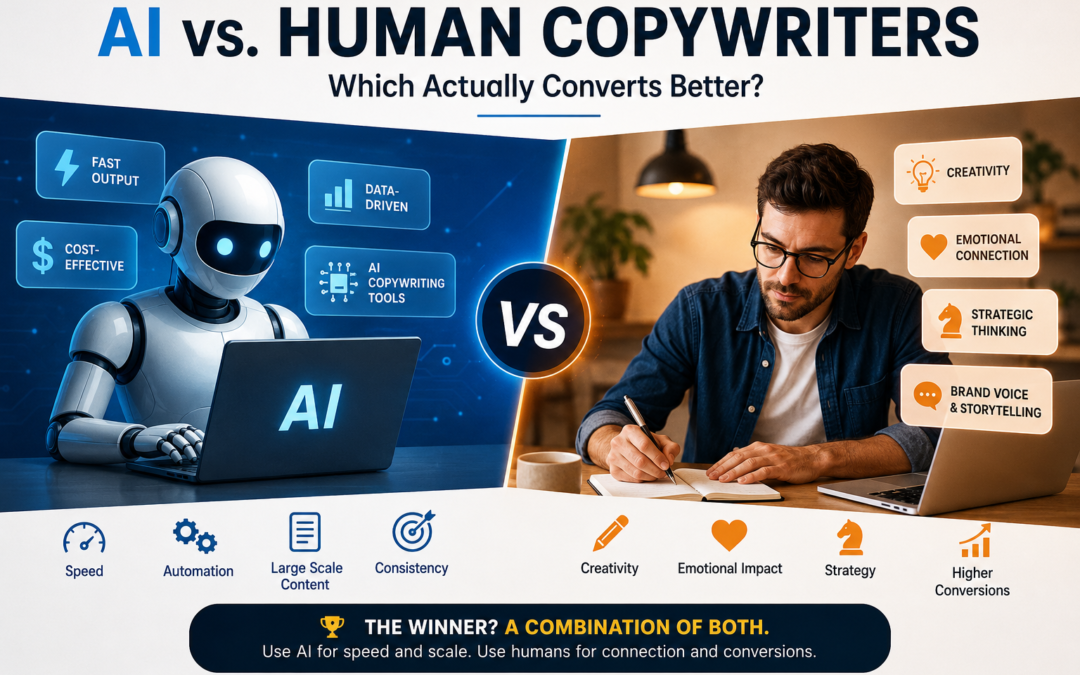
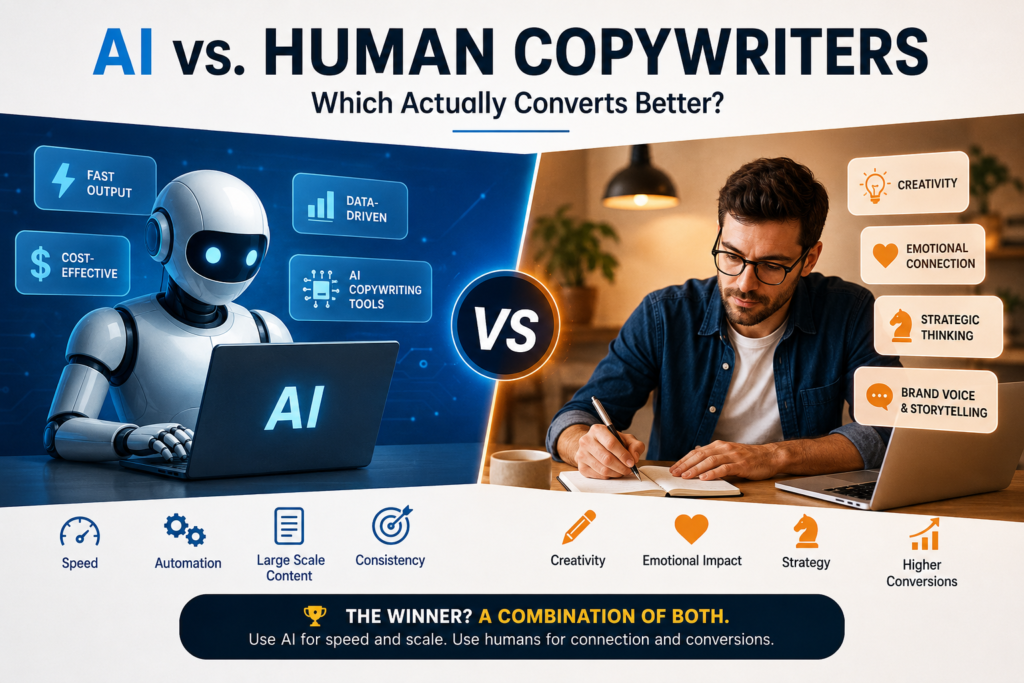
When it comes to conversions, the debate around AI vs human copywriters is not as simple as choosing one over the other. AI can create content faster and at a lower cost, while human copywriters bring creativity, emotional intelligence, and strategic thinking. In most cases, the highest-converting content comes from a combination of both. AI copywriting tools help with speed and research, while human writers refine messaging to connect with real people and drive action.
Introduction
Artificial intelligence is changing the way businesses create content. From blog posts and emails to product descriptions and ad copy, AI tools can generate content in seconds. This has led many companies to ask an important question:
Leading AI Copywriting Tools and AI Assistants in 2026
The AI content creation market has evolved beyond traditional copywriting software. Today, businesses use advanced AI assistants to create blogs, marketing campaigns, sales copy, emails, and research-driven content.
ChatGPT
ChatGPT is one of the most widely used AI writing tools. It helps businesses generate blog posts, landing page copy, email campaigns, product descriptions, and content briefs. Many marketers use ChatGPT to speed up content creation while relying on human editors to refine the final output.
Claude
Claude is known for producing natural-sounding long-form content. It is particularly useful for research-heavy articles, content editing, document analysis, and maintaining a consistent writing style across large projects.
Gemini
Gemini integrates closely with Google’s ecosystem and is often used for content ideation, research, and drafting marketing materials. Businesses that rely heavily on Google Workspace frequently incorporate Gemini into their content workflows.
Perplexity
Perplexity combines AI-generated responses with web-based research. Many content teams use it to gather information, identify sources, and validate facts before creating articles and marketing content.
AI vs human copywriters, Who is better?
The answer depends on what you mean by “better.”
If your goal is to produce large amounts of content quickly, AI may seem like the winner. But if your goal is maximizing conversions, building trust, and creating a strong brand voice, human expertise still plays a major role.
Today, businesses use both AI and human writers to create marketing content. Understanding the strengths and weaknesses of each can help you make smarter decisions for your content strategy.
In this guide, we will compare AI copywriting tools and human copywriters based on conversion performance, creativity, cost, speed, SEO, emotional impact, and long-term business value.
AI vs Human Copywriters: Understanding Conversion-Focused Copywriting
Before comparing AI and human writers, it is important to understand what conversion-focused copywriting means.
Copywriting is not just about writing words. It is about encouraging readers to take action.
That action could be:
- Buying a product
- Signing up for a newsletter
- Booking a consultation
- Requesting a quote
- Downloading a guide
- Starting a free trial
Good copywriting combines psychology, persuasion, clarity, and audience understanding.
The real question is not who writes faster.
The real question is:
Who creates content that motivates people to act?
What Are AI Copywriting Tools?
AI copywriting tools are software programs that use machine learning and natural language processing to generate written content.
Popular AI copywriting tools can create:
- Blog articles
- Email campaigns
- Social media posts
- Landing page copy
- Product descriptions
- Advertising copy
- Video scripts
These tools analyze huge amounts of data and predict the most likely words to use based on user prompts.
AI vs Human Copywriters: Benefits of AI Copywriting Tools
AI tools offer several advantages:
Fast Content Creation
A task that takes a human several hours can often be completed by AI in minutes.
Lower Content Costs
Businesses can create more content without hiring large writing teams.
Consistent Output
AI can maintain a consistent tone and structure across multiple pieces of content.
Content Scaling
Companies producing hundreds of pages each month can scale their content operations quickly.
Idea Generation
AI helps overcome writer’s block by generating headlines, outlines, and topic ideas.
What Human Copywriters Bring to the Table
Human copywriters do much more than write.
They understand:
- Human emotions
- Customer pain points
- Brand positioning
- Cultural context
- Buying behavior
- Market trends
A skilled copywriter can identify what motivates a specific audience and craft messages that feel authentic and persuasive.
AI vs Human Copywriters: Advantages of Human Copywriters
Emotional Connection
People buy based on emotions and justify purchases with logic.
Human writers understand emotional triggers better than AI.
Original Storytelling
Stories create trust and memorability.
Human copywriters can share experiences, case studies, and narratives that resonate with readers.
Strategic Thinking
Copywriting is often connected to business goals.
Human writers can align content with broader marketing strategies.
Brand Voice Development
Strong brands have unique personalities.
Humans are better at creating and maintaining distinctive brand voices.
Critical Thinking
Human writers can analyze situations, identify gaps, and make judgment calls that AI struggles with.
AI vs Human Copywriters: Key Differences
Speed
AI wins when speed is the priority.
An AI tool can generate:
- Blog outlines in seconds
- Ad variations instantly
- Email drafts quickly
Human writers require more time for research, planning, and editing.
Winner: AI
Creativity
AI creates content based on patterns.
Humans create content based on imagination, experience, and insight.
Creative campaigns often require original thinking that AI cannot fully replicate.
Winner: Human Copywriters
Emotional Persuasion
Conversion-focused content relies heavily on emotions.
Human writers understand:
- Fear
- Excitement
- Trust
- Urgency
- Aspirations
AI can imitate emotional language but may not fully understand emotional context.
Winner: Human Copywriters
Cost
AI tools are generally less expensive than hiring professional copywriters.
Businesses with limited budgets often use AI to reduce content costs.
Winner: AI
Accuracy
AI sometimes generates incorrect information.
Human writers can verify facts and provide better quality control.
Winner: Human Copywriters
Consistency
AI can maintain a consistent structure across large volumes of content.
Winner: AI
Strategic Marketing Insight
Effective copywriting requires understanding customer journeys and business objectives.
Humans excel at connecting content with strategy.
Winner: Human Copywriters
Which Converts Better?
The answer depends on the type of content.
When AI Converts Well
AI-generated content performs reasonably well for:
- Product descriptions
- Basic landing pages
- FAQ pages
- Simple email campaigns
- Routine blog content
For straightforward information, AI can achieve acceptable conversion rates.
When Humans Convert Better
Human copywriters usually outperform AI for:
- High-ticket sales pages
- Brand storytelling
- Complex services
- Emotional campaigns
- Luxury products
- B2B decision-making content
These situations require trust, persuasion, and nuanced messaging.
Why Human Psychology Still Matters
Marketing is ultimately about people.
People do not purchase products simply because information exists.
They purchase because they believe a product solves a problem.
Human copywriters understand:
- Objections
- Fears
- Motivations
- Desires
- Decision-making behavior
These psychological factors strongly influence conversion rates.
A human writer can identify hidden customer concerns and address them directly.
This often leads to higher conversion performance.
How AI Copywriting Tools Improve Conversion Optimization
Although human writers excel in persuasion, AI tools still provide significant value.
Rapid Testing
AI can generate dozens of:
- Headlines
- Call-to-action buttons
- Subject lines
- Ad variations
Marketers can test multiple versions quickly.
Data Analysis
AI helps identify patterns in customer behavior and engagement.
Content Personalization
Some AI systems personalize content for different audience segments.
Faster Campaign Deployment
Businesses can launch campaigns more quickly.
This speed can create competitive advantages.
The Best Approach: AI Plus Human Copywriters
Many successful companies are no longer choosing between AI and humans.
Instead, they combine both.
A Practical Workflow
Step 1: Use AI for research and outlines.
Step 2: Generate first drafts with AI.
Step 3: Human copywriters edit and improve messaging.
Step 4: Add brand voice and emotional elements.
Step 5: Optimize for conversions and SEO.
This approach delivers:
- Faster production
- Better quality
- Higher conversion potential
SEO Performance: AI vs Human Copywriters
Search engines prioritize helpful content.
This means content should:
- Answer user questions
- Provide value
- Demonstrate expertise
- Show experience
- Be trustworthy
Where AI Helps SEO
AI can:
- Generate topic ideas
- Build content outlines
- Suggest keywords
- Create metadata
Where Humans Help SEO
Human writers improve:
- Search intent matching
- Content depth
- Reader engagement
- Unique insights
- Experience-based information
The strongest SEO results typically come from combining AI support with human expertise.
Common Mistakes Businesses Make: AI vs Human Copywriters
Relying Entirely on AI
Publishing AI-generated content without editing can lead to:
- Generic writing
- Repetitive wording
- Weak brand voice
- Lower trust
Ignoring AI Completely
Avoiding AI means missing opportunities for:
- Faster workflows
- Greater productivity
- Content scaling
Prioritizing Quantity Over Quality
More content does not automatically mean more conversions.
Quality remains the most important factor.
AI vs Human Copywriters: Industries Where Human Writers Have a Strong Advantage
Certain industries require high levels of trust and expertise.
Examples include:
Healthcare
Medical content must be accurate and trustworthy.
Finance
Financial decisions involve risk and credibility.
Legal Services
Legal content requires precision and clarity.
Luxury Brands
Luxury marketing relies heavily on storytelling and emotional appeal.
High-Ticket B2B Services
Complex buying decisions often require persuasive, expert-driven content.
The Future of Copywriting
The future is unlikely to be AI versus humans.
Instead, it will be AI working alongside humans.
AI will continue improving.
Human writers will focus more on:
- Strategy
- Creativity
- Brand development
- Emotional storytelling
- Conversion optimization
Businesses that combine both will gain the greatest advantage.
Final Verdict: AI vs Human Copywriters
So, which actually converts better?
For simple and scalable content, AI copywriting tools can deliver solid results.
For persuasive, emotional, and high-converting marketing content, human copywriters generally perform better.
The strongest conversion strategy combines the strengths of both.
Use AI for speed, efficiency, and content generation.
Use human copywriters for strategy, creativity, emotional connection, and conversion optimization.
In today’s marketing landscape, the winner is not AI alone or humans alone.
The winner is the business that knows how to use both effectively.
Frequently Asked Questions
Can AI completely replace human copywriters?
No. AI can assist with content creation, but human writers provide creativity, emotional intelligence, and strategic thinking that remain difficult to automate.
Do AI copywriting tools improve conversions?
They can improve efficiency and help generate ideas, but conversion results often improve when human editors refine the content.
Are AI-generated articles good for SEO?
AI-generated content can rank if it is accurate, helpful, and edited for quality. Search engines focus on content value rather than how it is created.
What are the best uses of AI copywriting tools?
AI works well for content outlines, product descriptions, email drafts, headline generation, and content scaling.
Why do human copywriters still matter?
Human copywriters understand customer psychology, storytelling, and emotional persuasion, which often have a direct impact on conversion rates.
Should small businesses use AI or hire a copywriter?
A combination of both is often the most cost-effective solution. AI can speed up production, while professional copywriters improve quality and conversions.
Which converts better: AI or human-written sales copy?
Human-written sales copy generally converts better because it addresses emotions, objections, and customer motivations more effectively.
What is the biggest advantage of AI copywriting tools?
The biggest advantage is speed. AI can generate large volumes of content quickly and at a lower cost.