
Contents
- 1 Quick Summary
- 2 Introduction
- 3 What Does a Digital Marketing Freelancer Do?
- 4 Why Digital Marketing Is a Good Freelancing Career
- 5 Step 1: Choose One Digital Marketing Skill to Start With
- 6 How to choose your first skill
- 7 Step 2: Learn the Skill Properly
- 8 Step 3: Practice Before You Start Pitching
- 9 Ways to practice your digital marketing skill
- 10 Step 4: Build a Simple Portfolio
- 11 What to include in your portfolio
- 12 Step 5: Decide What Service You Will Sell First
- 13 Good service offer formula
- 14 Step 6: Set Up Your Online Presence
- 15 What to set up
- 16 Step 7: Start Finding Your First Clients
- 17 Ways to find freelance digital marketing clients
- 18 Step 8: Price Your Services Simply
- 19 Common pricing models
- 20 Beginner pricing tip
- 21 Step 9: Focus on Client Results and Communication
- 22 What clients care about most
- 23 Step 10: Grow Slowly Instead of Doing Everything at Once
- 24 Common Mistakes New Digital Marketing Freelancers Make
- 25 Trying to learn everything at once
- 26 Waiting too long to start
- 27 Offering vague services
- 28 Having no portfolio
- 29 Copying everyone else
- 30 Ignoring follow-up
- 31 Can You Really Earn Well as a Digital Marketing Freelancer?
- 32 Final Thoughts
- 33 FAQs
- 33.1 Do I need a degree to become a digital marketing freelancer?
- 33.2 Which digital marketing skill is best for beginners?
- 33.3 How do I get my first freelance digital marketing client?
- 33.4 Can I start digital marketing freelancing without experience?
- 33.5 How much can a digital marketing freelancer earn?
- 33.6 Is digital marketing freelancing good for students?
- 33.7 How long does it take to start freelancing in digital marketing?
Quick Summary
If you want to know how to start freelancing in digital marketing, the best way is to first learn one practical skill like SEO, content writing, social media marketing, or Google Ads. Then build a small portfolio, create a simple online presence, and start reaching out to potential clients. You do not need a degree or years of experience to begin. You need a useful skill, proof that you can do the work, and a clear plan to get your first client as a digital marketing freelancer.
Introduction
Freelancing in digital marketing has become one of the most practical ways to start earning online. Businesses of all sizes need help with online growth. They want more traffic, better visibility, more leads, and a stronger social media presence. This creates a huge opportunity for beginners who are willing to learn the right skills and offer useful services.
The good news is that you do not need to be an expert in everything to begin. You also do not need a big team, expensive tools, or years of job experience. If you learn one digital marketing skill properly, practice it, and present your work well, you can start building a freelance career step by step.
But many beginners feel confused at the start. They are not sure which skill to learn, how to find clients, or how to charge for their work. Some think freelancing only works if you already have a big network or years of experience. That is not true.
This guide will show you how to start freelancing in digital marketing in a practical and beginner-friendly way. It covers the skills you can learn, how to build your portfolio, where to find clients, and how to grow as a digital marketing freelancer.
What Does a Digital Marketing Freelancer Do?
A digital marketing freelancer helps businesses improve their online presence and get better results from digital channels. Instead of working as a full-time employee for one company, a freelancer works independently and offers services to multiple clients.
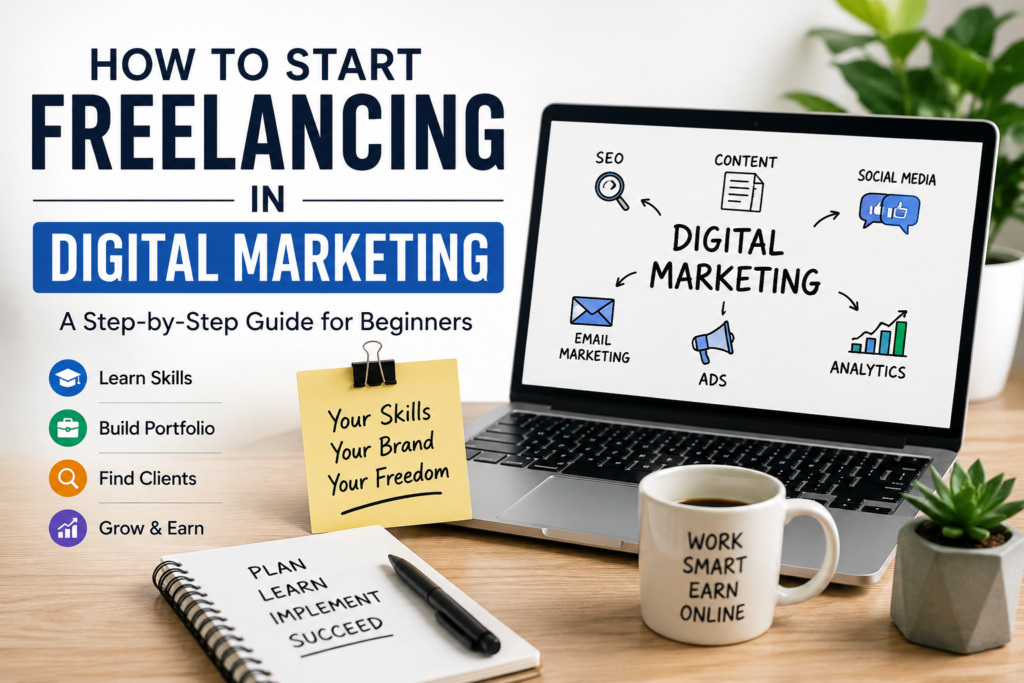
A digital marketing freelancer may help with:
- SEO and website optimization
- Blog writing and content marketing
- Google Ads and paid campaigns
- Social media content and management
- Email marketing
- Lead generation
- Analytics and reporting
- Local SEO for small businesses
You do not need to offer all these services. In fact, starting with one clear skill is usually the smartest move.
Why Digital Marketing Is a Good Freelancing Career
Digital marketing is one of the best freelancing fields for beginners because the demand is strong and the entry barrier is lower than many other careers.
1. Businesses always need online marketing help
Almost every business wants more visibility online. A local salon wants more people to find it on Google. A coach wants leads from Instagram. An eCommerce brand wants better ad performance. A software company wants more traffic from SEO. This means there are many types of clients looking for digital marketing support.
2. You can start with one skill
You do not have to learn everything at once. You can start with one service, get good at it, and then expand later.
3. You can work from home
Freelancing in digital marketing is remote-friendly. You can work with clients from your city, your country, or anywhere in the world.
4. It can become a long-term career
What starts as a side income can grow into a full-time freelance business, consulting career, or even a small agency.
Step 1: Choose One Digital Marketing Skill to Start With
The first step in learning how to start freelancing in digital marketing is choosing one skill to focus on.
This is important because beginners often try to learn SEO, ads, content, email, design, and social media all at the same time. That usually leads to confusion and slow progress.
Start with one skill that is useful, learnable, and in demand.
Good digital marketing skills for beginners
SEO
Search Engine Optimization is a great option if you like content, websites, and search engines. You can offer keyword research, on-page SEO, blog optimization, internal linking, and content strategy.
Content writing
If you enjoy writing, SEO blog writing and website content writing are strong beginner-friendly services. Many businesses need blog posts, landing pages, and service page content.
Social media management
This can include content planning, captions, posting schedules, basic engagement, and content ideas for platforms like Instagram, LinkedIn, or Facebook.
Google Ads
If you like data and paid campaigns, you can learn the basics of Google Ads and eventually offer ad setup, keyword targeting, and campaign optimization.
Email marketing
Businesses often need newsletters, welcome sequences, promotional emails, and abandoned cart emails. If you like writing and customer journeys, email marketing can be a smart niche.
How to choose your first skill
Ask yourself:
- What do I enjoy doing?
- What can I learn and practice quickly?
- What service can solve a real problem for a business?
- Which skill feels realistic for me to start with?
You do not need the perfect answer. You just need one clear starting point.
Step 2: Learn the Skill Properly
Once you choose your service, spend time learning the basics and understanding how the work is actually done.
If you choose SEO, learn:
- keyword research
- search intent
- title tags and meta descriptions
- heading structure
- internal linking
- basic on-page SEO
If you choose content writing, learn:
- How to write blog posts that match search intent
- How to structure content with headings
- How to write clear intros and CTAs
- How to make content readable and useful
If you choose social media management, learn:
- content planning
- brand voice basics
- caption writing
- posting consistency
- simple reporting
The goal is not to collect endless information. The goal is to become good enough to deliver one useful service with confidence.
Step 3: Practice Before You Start Pitching
A common mistake beginners make is trying to get clients before they have done any real practice. Even if you do not have a paid client yet, you can still create work samples.
Ways to practice your digital marketing skill
Create a personal project
Start a simple blog, Instagram page, or niche website and use it to practice your skill. If you are learning SEO, write articles and optimize them. If you are learning social media, grow a small page around a topic you enjoy.
Improve a sample business
Choose a real business website and create a sample audit. For example:
- suggest better title tags
- rewrite a homepage section
- show a simple keyword plan
- create sample social media captions
Do mock projects
Write a blog post for an imaginary client. Build a content calendar for a fake skincare brand. Create a sample Google Ads plan for a local gym. These are not fake in a bad way. They are practice pieces that show how you think and work.
This practice is important because it helps you build confidence and gives you something to show when clients ask for examples.
Step 4: Build a Simple Portfolio
You do not need a huge website to look professional. But you do need proof of work.
Your portfolio can be a Google Drive folder, Notion page, PDF, or simple website. It should show what you do and how you can help.
What to include in your portfolio
- A short intro about who you are
- The service you offer
- 2 to 5 work samples
- A short explanation of what you did in each sample
- Any results, if available
- Your contact details
Example portfolio items
If you offer SEO content writing:
- a blog post you wrote
- a content outline based on keyword research
- before-and-after improvements for a page
If you offer SEO:
- a basic website audit
- keyword research for a business
- title and meta optimization examples
If you offer social media:
- a one-week content plan
- caption samples
- post ideas for a business niche
Keep it simple. Clarity matters more than fancy design.
Step 5: Decide What Service You Will Sell First
Now that you have a skill and some proof of work, decide what exactly you want to offer clients.
Do not say “I do digital marketing.” That is too broad.
Instead, create a simple service offer such as:
- SEO blog writing for service businesses
- on-page SEO for small business websites
- Instagram content management for local brands
- Google Ads setup for lead generation
- email newsletter writing for coaches and consultants
A clear offer makes it easier for people to understand your value.
Good service offer formula
I help [type of client] achieve [result] through [service].
Examples:
- I help small businesses get more organic traffic through SEO content writing.
- I help local businesses improve Google visibility with on-page SEO.
- I help coaches get more leads through email marketing.
This kind of positioning makes you easier to hire.
Step 6: Set Up Your Online Presence
If you want clients to trust you, they need to see that you are real and serious about your work.
You do not need to be active on every platform. Start with a simple professional presence.
What to set up
- A LinkedIn profile
- A basic portfolio page or Google Drive portfolio
- A professional email address
- A simple Instagram page or personal website if relevant
Your LinkedIn headline should clearly say what you do. For example:
Digital Marketing Freelancer | SEO Content Writer for Small Businesses
or
Freelance SEO Specialist Helping Brands Improve Organic Traffic
Keep your profile focused on the service you want to sell.
Step 7: Start Finding Your First Clients
This is the part most beginners worry about. The truth is, your first clients may not come quickly, but they do come if you stay consistent and take action.
Ways to find freelance digital marketing clients
1. Reach out to small businesses directly
Look for businesses that clearly need help. Maybe their website has poor SEO, their blog is outdated, or their social media is inactive. Send a short, personalized message explaining one thing you noticed and how you can help.
2. Use LinkedIn
Connect with business owners, founders, and marketing managers. Share useful content related to your skill. Engage with posts. Reach out politely when relevant.
3. Ask your network
Tell friends, family, old classmates, and former colleagues what service you offer. Sometimes your first opportunity comes from someone who already knows you.
4. Use freelancing platforms carefully
Websites like Upwork and Fiverr can help beginners, but competition is high. If you use them, focus on one clear service and create a strong profile.
5. Join communities
Facebook groups, Slack groups, and business communities can be useful if you contribute genuinely and do not just spam offers.
Step 8: Price Your Services Simply
Pricing feels difficult at first, but do not overcomplicate it. In the beginning, your goal is not to charge the highest rate in the market. Your goal is to charge fairly while gaining experience and confidence.
Common pricing models
- Per project – best for blog writing, audits, landing pages, or one-time setups
- Monthly retainer – best for ongoing SEO, content, or social media work
- Hourly – useful if the scope is unclear, though many freelancers prefer project pricing
Beginner pricing tip
Start with a rate that feels fair for your skill level and the value of the task. As you gain confidence, testimonials, and better results, increase your pricing gradually.
Do not position yourself as “cheap.” Position yourself as clear, reliable, and useful.
Step 9: Focus on Client Results and Communication
Getting a client is only the beginning. If you want repeat work and referrals, you need to deliver good work and communicate well.
What clients care about most
- Did you understand the task?
- Did you deliver on time?
- Was your work clear and useful?
- Did you communicate properly?
- Did you help move the business toward a result?
Even if you are still learning, strong communication can set you apart. Be honest, ask smart questions, and keep clients updated.
Step 10: Grow Slowly Instead of Doing Everything at Once
Once you get a few projects, you may feel pressure to offer more services. Try not to rush.
It is usually better to become known for one thing first.
For example:
- Start with SEO blog writing
- Then add content strategy
- Then offer on-page SEO
- Later move into full SEO consulting if you want
Growth works better when it is built on a strong base.
Common Mistakes New Digital Marketing Freelancers Make
Trying to learn everything at once
This leads to overwhelm. Start with one skill.
Waiting too long to start
You do not need to be perfect. Learn the basics, practice, and begin.
Offering vague services
Clients need to understand exactly what you do.
Having no portfolio
Even sample work is better than nothing.
Copying everyone else
Your offer, communication, and content should feel like you.
Ignoring follow-up
Sometimes clients do not reply to the first message. A polite follow-up can help.
Can You Really Earn Well as a Digital Marketing Freelancer?
Yes, but income depends on your skill, consistency, service quality, niche, and ability to get clients.
In the beginning, freelancing may feel slow. You may start with one small project. Then one client turns into two. A small content writing job becomes a monthly retainer. A basic SEO audit becomes ongoing optimization work.
Freelancing income usually grows in stages:
- learning and practice
- first paid project
- repeat clients
- better positioning and higher pricing
- stable monthly income
The people who do well are not always the most talented. They are often the ones who stay consistent, keep improving, and continue showing up.
Final Thoughts
If you have been wondering how to start freelancing in digital marketing, the answer is simpler than it seems. You do not need to know everything, and you do not need to wait until you feel fully ready.
Start with one skill. Learn it properly. Practice it on your own project or sample work. Build a simple portfolio. Create a clear service offer. Reach out to potential clients and keep improving as you go.
That is how most freelance careers begin. Not with perfection, but with a small skill, a clear offer, and consistent action.
If you stay patient and keep learning, you can absolutely build a real career as a digital marketing freelancer.
FAQs
Do I need a degree to become a digital marketing freelancer?
No. Clients care more about your skills, your work, and your ability to solve problems than your degree.
Which digital marketing skill is best for beginners?
SEO content writing, on-page SEO, social media management, and email marketing are often good beginner-friendly choices.
How do I get my first freelance digital marketing client?
Start by building a portfolio, then reach out to small businesses, use LinkedIn, ask your network, and explore freelancing platforms.
Can I start digital marketing freelancing without experience?
Yes. You can build sample work, personal projects, and mock case studies to show your skills before getting your first paid client.
How much can a digital marketing freelancer earn?
It depends on your skill, niche, experience, and pricing. Some freelancers earn side income, while others turn it into a full-time business.
Is digital marketing freelancing good for students?
Yes. It is flexible, can be done remotely, and allows students to build a skill that can earn money while studying.
How long does it take to start freelancing in digital marketing?
If you stay focused, you can learn one skill, build sample work, and start pitching within a few weeks to a few months, depending on your pace.