
Contents
- 1 Quick Answer
- 2 Table of Contents
- 3 What Is Performance Marketing?
- 4 How Does Performance Marketing Work?
- 5 Why Is Performance Marketing Important in 2026?
- 6 Better Return on Investment
- 7 Data-Driven Decision Making
- 8 Highly Targeted Advertising
- 9 Easy to Measure Success
- 10 Traditional Marketing vs Performance Marketing
- 11 The Key Players in Performance Marketing
- 12 Popular Performance Marketing Channels
- 13 Common Performance Marketing Pricing Models
- 14 Real-World Performance Marketing Examples
- 15 How to Create an Effective Performance Marketing Strategy
- 16 2. Understand Your Target Audience
- 17 3. Choose the Right Performance Marketing Channels
- 18 4. Create High-Converting Landing Pages
- 19 5. Track the Right Metrics
- 20 Best Tools for Performance Marketing
- 21 Common Performance Marketing Mistakes
- 22 Performance Marketing Trends in 2026
- 23 Performance Marketing vs Digital Marketing
- 24 Is Performance Marketing Right for Every Business?
- 25 Frequently Asked Questions
- 25.1 What is performance marketing in simple words?
- 25.2 What is the difference between digital marketing and performance marketing?
- 25.3 What are the most popular performance marketing channels?
- 25.4 Why is performance marketing important?
- 25.5 Is SEO part of performance marketing?
- 25.6 Which businesses benefit the most from performance marketing?
- 25.7 How do beginners start with performance marketing?
- 25.8 Is performance marketing expensive?
- 25.9 What skills are required for performance marketing?
- 25.10 What is the future of performance marketing?
- 26 Final Thoughts
Quick Answer
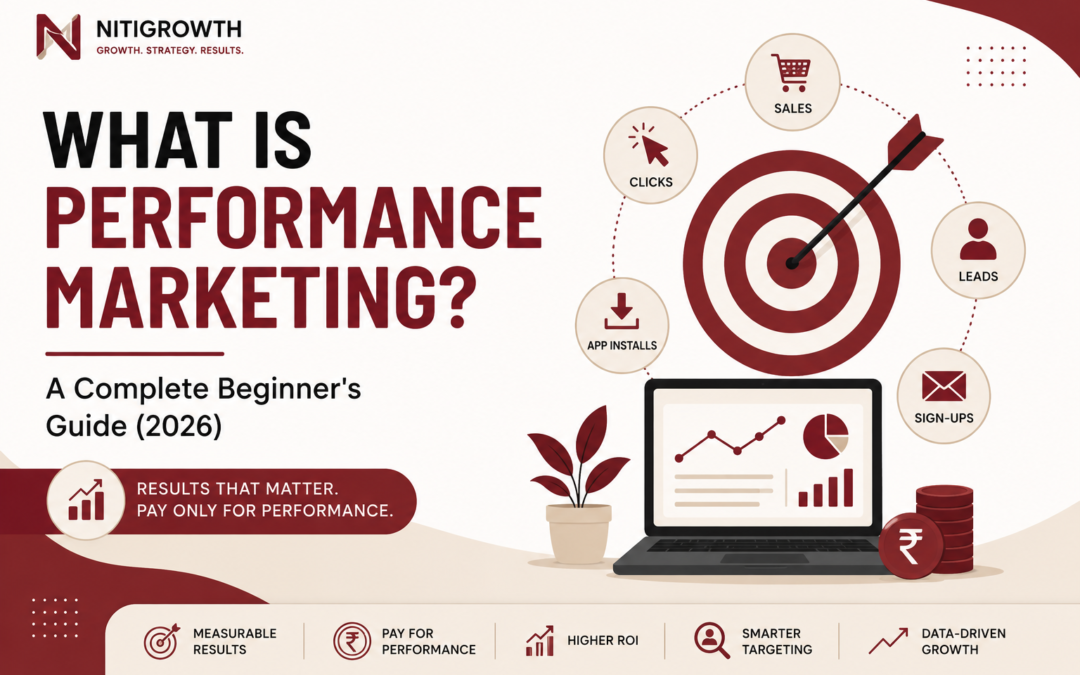
Performance marketing is a digital marketing approach where businesses pay only when a specific action is completed, such as a click, lead, sale, or app download. Unlike traditional advertising, payment is based on measurable results, making performance marketing one of the most cost-effective and data-driven marketing strategies for businesses of all sizes.
Table of Contents
- What Is Performance Marketing?
- How Does Performance Marketing Work?
- Why Is Performance Marketing Important?
- Traditional Marketing vs Performance Marketing
- The Key Players in Performance Marketing
- Popular Performance Marketing Channels
- Types of Performance Marketing Campaigns
- How to Build a Performance Marketing Strategy (Continued in Part 2)
- Common Mistakes to Avoid (Continued in Part 2)
- FAQs (Continued in Part 2)
What Is Performance Marketing?
Imagine paying a newspaper to advertise your business without knowing whether anyone will buy your product. That is how traditional advertising often works—you pay upfront and hope for the best.
Performance marketing is different.
With performance marketing, you only pay when your advertisement achieves a specific goal. That goal could be:
- A customer clicks your ad.
- Someone fills out a contact form.
- A visitor purchases your product.
- A user installs your mobile app.
- A customer subscribes to your newsletter.
This results-based approach allows businesses to measure every rupee or dollar spent, making it easier to calculate return on investment (ROI).
Because every campaign is measurable, businesses can improve performance over time using real data instead of guesswork.
How Does Performance Marketing Work?
At its core, performance marketing is built on measurable outcomes.
Here’s a simple example.
Suppose you own an online clothing store.
Instead of paying ₹50,000 for a billboard and hoping customers visit your website, you run Google Ads.
You decide you’ll only pay when someone clicks your advertisement.
If nobody clicks, you spend nothing.
If 500 people click and 50 make a purchase, you can easily calculate how much each customer cost to acquire.
This data helps you improve future campaigns and spend your marketing budget more effectively.
The Basic Process
- Create a marketing campaign.
- Choose your target audience.
- Launch advertisements.
- Track user actions.
- Measure campaign performance.
- Optimize based on data.
- Scale successful campaigns.
Every decision is based on numbers rather than assumptions.
Why Is Performance Marketing Important in 2026?
Digital marketing is becoming more competitive every year.
Businesses can no longer afford to waste money on campaigns that don’t deliver results.
Performance marketing solves this problem by making every campaign measurable.
Here are some reasons why businesses are investing heavily in performance marketing in 2026.
Better Return on Investment
Every business wants better returns from its marketing budget.
Since performance marketing focuses on measurable actions, companies know exactly where their money is being spent.
Instead of guessing which advertisements work, marketers can identify winning campaigns quickly.
Data-Driven Decision Making
Performance marketing provides detailed analytics.
Businesses can monitor:
- Website traffic
- Click-through rate (CTR)
- Cost per Click (CPC)
- Conversion Rate
- Cost per Acquisition (CPA)
- Return on Ad Spend (ROAS)
These insights help businesses improve campaigns continuously.
Highly Targeted Advertising
Unlike traditional marketing, digital platforms allow businesses to target very specific audiences.
You can advertise based on:
- Age
- Gender
- Interests
- Location
- Income
- Online behavior
- Purchase history
This improves campaign efficiency while reducing unnecessary spending.
Easy to Measure Success
One of the biggest advantages of performance marketing is transparency.
Businesses can answer questions like:
- Which advertisement generated the most sales?
- Which keyword produced the highest conversions?
- Which audience converts best?
- Which platform gives the highest ROI?
These answers help businesses make smarter marketing decisions.
Traditional Marketing vs Performance Marketing
Many beginners confuse traditional marketing with performance marketing.
Although both aim to increase sales and brand awareness, they work very differently.
| Traditional Marketing | Performance Marketing |
|---|---|
| Payment made before results | Payment based on measurable results |
| Difficult to measure ROI | ROI is easy to calculate |
| Broad audience targeting | Precise audience targeting |
| Limited performance data | Detailed analytics available |
| Campaign optimization is difficult | Campaigns can be optimized in real time |
| Mostly offline | Primarily digital |
Performance marketing gives businesses more control over their budget because every campaign can be monitored and improved.
The Key Players in Performance Marketing
A successful performance marketing campaign involves several participants working together.
Advertisers
Advertisers are businesses promoting their products or services.
Examples include:
- E-commerce stores
- SaaS companies
- Local businesses
- Educational platforms
- Healthcare providers
Their goal is to generate measurable results such as sales or leads.
Publishers
Publishers display advertisements to their audience.
They can include:
- Websites
- Blogs
- News portals
- Mobile apps
- YouTube channels
Publishers earn revenue whenever campaigns achieve their agreed objectives.
Affiliate Marketers
Affiliate marketers promote products using their own audience.
Whenever someone purchases through their referral link, they receive a commission.
Affiliate marketing has become one of the fastest-growing areas of performance marketing.
Advertising Platforms
Advertising platforms connect businesses with potential customers.
Some of the most popular platforms include:
- Google Ads
- Meta Ads
- LinkedIn Ads
- Microsoft Ads
- TikTok Ads
- Pinterest Ads
Each platform offers different targeting options and campaign objectives.
Popular Performance Marketing Channels
Choosing the right performance marketing channels plays a major role in campaign success.
Here are the most effective channels businesses use today.
Search Engine Advertising
Search advertising allows businesses to appear when users search for specific keywords.
For example:
A person searching for “best running shoes” may see sponsored Google Ads before the organic search results.
This channel works well because users already have buying intent.
Social Media Advertising
Social media platforms help businesses reach highly targeted audiences.
Popular platforms include:
Businesses can target users based on demographics, interests, online behavior, and purchasing patterns.
Affiliate Marketing
Affiliate marketing involves paying partners only when they generate measurable results.
This could include:
- Sales
- Leads
- App installs
- Sign-ups
Because payment depends on performance, affiliate marketing remains one of the most cost-effective strategies.
Native Advertising
Native advertisements blend naturally into website content.
Instead of looking like traditional advertisements, they appear as recommended articles or sponsored content.
Because native ads feel less intrusive, they often receive higher engagement.
Email Marketing
Although often overlooked, email marketing is still a powerful performance marketing channel.
Businesses can:
- Promote products
- Recover abandoned carts
- Share special offers
- Generate repeat sales
Since results are measurable, marketers can improve open rates and conversion rates over time.
Influencer Marketing
Many brands now collaborate with creators and influencers to promote products.
Instead of paying only for visibility, businesses increasingly structure partnerships around measurable outcomes such as:
- Sales
- Coupon redemptions
- App downloads
- Website visits
This makes influencer marketing another growing area within performance marketing.
Common Performance Marketing Pricing Models
Different campaigns use different payment models depending on business objectives.
Cost Per Click (CPC)
Businesses pay each time someone clicks their advertisement.
Ideal for:
- Website traffic
- Lead generation
- Search advertising
Cost Per Acquisition (CPA)
Businesses pay only when a desired action is completed.
Examples include:
- Purchase
- Registration
- Lead submission
CPA campaigns are popular because they directly align marketing costs with business outcomes.
Cost Per Mille (CPM)
CPM means paying for every 1,000 ad impressions.
This model focuses more on visibility than direct conversions.
Cost Per Lead (CPL)
Businesses pay only when a qualified lead is generated.
This pricing model is commonly used by:
- Insurance companies
- Educational institutions
- Real estate agencies
- B2B businesses
Real-World Performance Marketing Examples
Understanding performance marketing examples makes the concept easier to grasp.
Example 1: Online Clothing Store
A fashion retailer runs Google Shopping Ads.
The business only pays when shoppers click the product listing.
If those clicks result in sales, the campaign generates measurable revenue.
Example 2: Online Course Platform
An education company promotes its courses through Facebook Ads.
Instead of paying for exposure alone, it measures:
- Course enrollments
- Cost per lead
- Cost per purchase
- Return on Ad Spend
Using this data, the company continuously improves its campaigns and increases profitability.
How to Create an Effective Performance Marketing Strategy
A successful performance marketing strategy is not just about running ads. It starts with understanding your business goals, identifying the right audience, choosing the best marketing channels, and continuously improving campaigns using real data.
Let’s look at each step.
1. Define Clear Business Goals
Every campaign should begin with a measurable objective.
Ask yourself:
- Do you want more website traffic?
- Do you want to generate qualified leads?
- Do you want more online sales?
- Are you trying to increase app downloads?
- Do you want people to subscribe to your newsletter?
Setting clear goals helps you measure success accurately.
For example:
- Generate 500 leads in one month
- Increase website sales by 20%
- Reduce cost per acquisition by 15%
Without clear goals, it becomes difficult to determine whether your campaign is successful.
2. Understand Your Target Audience
One of the biggest advantages of performance marketing is precise audience targeting.
Before launching any campaign, understand:
- Age group
- Gender
- Location
- Interests
- Buying behavior
- Pain points
- Devices they use
- Online platforms they spend time on
The more you understand your audience, the better your advertisements will perform.
3. Choose the Right Performance Marketing Channels
Not every platform works for every business.
Here are some common examples.
Google Ads
Best for:
- Local businesses
- E-commerce stores
- Service providers
- High purchase intent
Meta Ads (Facebook & Instagram)
Best for:
- Brand awareness
- Lead generation
- Online stores
- Small businesses
LinkedIn Ads
Best for:
- B2B businesses
- Professional services
- Software companies
Affiliate Marketing
Ideal when you want partners to promote your products while paying only for actual results.
Email Marketing
Perfect for:
- Customer retention
- Repeat purchases
- Product launches
- Personalized offers
Selecting the right performance marketing channels ensures your budget is spent where your customers are most active.
4. Create High-Converting Landing Pages
Even the best advertisement will fail if it sends users to a poor landing page.
Your landing page should include:
- Clear headline
- Strong value proposition
- Fast loading speed
- Simple navigation
- Trust signals
- Customer testimonials
- Easy contact form
- Clear Call-to-Action (CTA)
Remember, ads attract visitors, but landing pages convert them into customers.
5. Track the Right Metrics
Performance marketing is all about measuring results.
Some of the most important KPIs include:
Click-Through Rate (CTR)
Shows how many people clicked your advertisement after seeing it.
A higher CTR usually indicates that your ad is relevant and engaging.
Conversion Rate
Measures how many visitors completed the desired action.
Examples include:
- Purchasing a product
- Filling out a form
- Booking a consultation
Cost Per Click (CPC)
Shows how much you’re paying for each click.
Lower CPC with quality traffic often leads to better profitability.
Cost Per Acquisition (CPA)
This tells you how much it costs to acquire one customer.
Reducing CPA while maintaining conversions is a major goal of performance marketing.
Return on Ad Spend (ROAS)
ROAS measures how much revenue you generate for every amount spent on advertising.
For example:
Spend ₹10,000
Generate ₹50,000 in sales
ROAS = 5X
A higher ROAS indicates a more profitable campaign.
Best Tools for Performance Marketing
Professional marketers rely on data rather than assumptions.
Here are some useful tools.
| Tool | Purpose |
|---|---|
| Google Analytics 4 | Website traffic analysis |
| Google Ads | Search & Display advertising |
| Meta Ads Manager | Facebook & Instagram campaigns |
| Google Tag Manager | Event tracking |
| Google Search Console | Organic performance |
| Hotjar | User behavior analysis |
| Ahrefs | Competitor research |
| SEMrush | Keyword research |
| Canva | Ad creatives |
| Looker Studio | Marketing dashboards |
These tools help businesses monitor performance and make informed decisions.
Common Performance Marketing Mistakes
Many beginners waste their advertising budget because they overlook the basics.
Here are the most common mistakes.
Targeting Everyone
Trying to reach everyone usually means reaching no one effectively.
Instead, focus on a well-defined audience.
Ignoring Data
Many businesses launch campaigns and never analyze performance.
Successful marketers review data regularly and optimize campaigns based on insights.
Weak Landing Pages
A great advertisement cannot compensate for a poor website experience.
Ensure your landing page is optimized for conversions.
Poor Ad Creatives
Low-quality images and unclear messaging reduce engagement.
Create compelling visuals and write clear, benefit-focused copy.
Not Testing Campaigns
Always test different:
- Headlines
- Images
- CTAs
- Audiences
- Ad formats
Small improvements can significantly increase ROI over time.
Performance Marketing Trends in 2026
Digital marketing continues to evolve rapidly.
Here are some key trends shaping performance marketing.
AI-Powered Campaign Optimization
Artificial Intelligence helps marketers automate bidding, personalize ads, and improve targeting based on user behavior.
First-Party Data
As privacy regulations become stricter, businesses increasingly rely on their own customer data rather than third-party cookies.
Short-Form Video Advertising
Platforms like Instagram Reels and YouTube Shorts continue to drive strong engagement and conversions.
Voice Search Optimization
More users are searching using voice assistants, making conversational keywords increasingly important.
Predictive Analytics
Businesses now use AI and machine learning to predict customer behavior and optimize campaigns before problems arise.
Performance Marketing vs Digital Marketing
Many beginners assume both terms mean the same thing.
They don’t.
| Digital Marketing | Performance Marketing |
|---|---|
| Broad marketing approach | Results-focused strategy |
| Includes branding campaigns | Focuses on measurable actions |
| Success may take longer to measure | Performance is measurable immediately |
| May prioritize awareness | Prioritizes conversions and ROI |
| Includes organic and paid marketing | Primarily focuses on measurable paid campaigns |
Performance marketing is actually a subset of digital marketing.
Is Performance Marketing Right for Every Business?
The answer is yes, but the strategy should vary depending on your business type.
Performance marketing works particularly well for:
- E-commerce businesses
- SaaS companies
- Startups
- Educational institutions
- Healthcare providers
- Real estate agencies
- Local businesses
- Professional service firms
Whether your goal is generating leads or increasing online sales, performance marketing offers measurable and scalable solutions.
Frequently Asked Questions
What is performance marketing in simple words?
Performance marketing is a type of digital marketing where businesses pay only when a specific action, such as a click, lead, or sale, is completed.
What is the difference between digital marketing and performance marketing?
Digital marketing includes all online marketing activities, while performance marketing focuses specifically on campaigns with measurable results and payments based on performance.
What are the most popular performance marketing channels?
The most common performance marketing channels include Google Ads, Meta Ads, affiliate marketing, email marketing, native advertising, influencer marketing, and LinkedIn Ads.
Why is performance marketing important?
Performance marketing helps businesses measure every marketing expense, optimize campaigns, improve ROI, and make data-driven decisions.
Is SEO part of performance marketing?
SEO supports performance marketing by driving organic traffic and improving website visibility. However, SEO itself is generally considered a long-term organic digital marketing strategy rather than a paid performance marketing channel.
Which businesses benefit the most from performance marketing?
Almost every business can benefit, including startups, local businesses, online stores, SaaS companies, healthcare providers, and B2B organizations.
How do beginners start with performance marketing?
Start by defining your goals, understanding your audience, selecting one advertising platform, creating a landing page, launching a small campaign, and optimizing it using performance data.
Is performance marketing expensive?
Not necessarily. Since businesses pay based on measurable outcomes, campaigns can be scaled according to budget. Even small businesses can run effective performance marketing campaigns.
What skills are required for performance marketing?
Key skills include audience research, copywriting, analytics, campaign optimization, keyword research, conversion rate optimization, and data interpretation.
What is the future of performance marketing?
The future lies in AI-powered optimization, automation, first-party data, predictive analytics, and highly personalized customer experiences.
Final Thoughts
Performance marketing has transformed the way businesses advertise online. Instead of spending money without knowing the outcome, companies can now measure every click, lead, and sale with precision. This results-driven approach helps businesses improve ROI, reduce wasted ad spend, and make smarter marketing decisions.
Whether you’re a beginner, a startup founder, or an experienced marketer, understanding what performance marketing is is essential in today’s competitive digital landscape. By choosing the right performance marketing strategy, leveraging effective performance marketing channels, and learning from real-world performance marketing examples, you can build campaigns that deliver measurable and sustainable growth.
The key to success is continuous learning, testing, and optimization. Start with clear goals, monitor your data, refine your campaigns, and focus on delivering value to your audience. In 2026 and beyond, businesses that embrace performance marketing will be better positioned to grow efficiently and stay ahead of the competition.