
Contents
- 1 Quick Answer: SEO vs Google Ads
- 2 Introduction
- 3 Should I invest in SEO or Google Ads?
- 4 What Is SEO?
- 5 What does SEO include?
- 6 How SEO works in simple words
- 7 What Is Google Ads?
- 8 How Google Ads works
- 9 Types of Google Ads for SEO vs Google Ads
- 10 SEO vs Google Ads: The Core Difference
- 11 SEO vs Google Ads comparison table
- 12 SEO vs Google Ads: How User Behavior Changes the Decision
- 13 Searches with high buying intent
- 14 Searches with research intent
- 15 Searches with local intent
- 16 Benefits of SEO for Business Growth
- 17 Limitations of SEO
- 18 Benefits of Google Ads for Business Growth
- 19 Limitations of Google Ads
- 20 Google Ads vs SEO Cost: Which One Is More Affordable?
- 21 SEO costs
- 22 Google Ads costs
- 23 The real cost difference
- 24 So which is cheaper?
- 25 SEO vs Google Ads for Small Business
- 26 When Google Ads may be better for a small business
- 27 When SEO may be better for a small business
- 28 The best answer for many small businesses
- 29 When SEO Is Better Than Google Ads
- 30 When Google Ads Is Better Than SEO
- 31 When You Should Use SEO and Google Ads Together
- 32 A Practical Decision Framework: Should You Choose SEO or Google Ads?
- 33 SEO vs Google Ads by Business Type
- 34 Common Mistakes Businesses Make in the SEO vs Google Ads Decision
- 34.1 Mistake 1: Expecting SEO to work like ads
- 34.2 Mistake 2: Running Google Ads without conversion tracking
- 34.3 Mistake 3: Sending ad traffic to a weak page
- 34.4 Mistake 4: Choosing based only on cost, not profitability
- 34.5 Mistake 5: Ignoring search intent
- 34.6 Mistake 6: Treating SEO and Google Ads as enemies
- 35 A Simple 90-Day Plan for Businesses That Want Both
- 36 Final Verdict: SEO vs Google Ads — Which Is Better for Your Business?
- 37 FAQs: SEO vs Google Ads
- 37.1 Is SEO better than Google Ads?
- 37.2 What is the difference between SEO and Google Ads?
- 37.3 Which is better for small business: SEO or Google Ads?
- 37.4 Is SEO cheaper than Google Ads?
- 37.5 How long does SEO take compared to Google Ads?
- 37.6 Can I do SEO and Google Ads at the same time?
- 37.7 Does Google Ads help SEO directly?
- 37.8 Should a new website start with SEO or Google Ads?
- 37.9 Which has better ROI: SEO or Google Ads?
- 37.10 Is Google Ads worth it for local businesses?
- 38 Conclusion
Quick Answer: SEO vs Google Ads
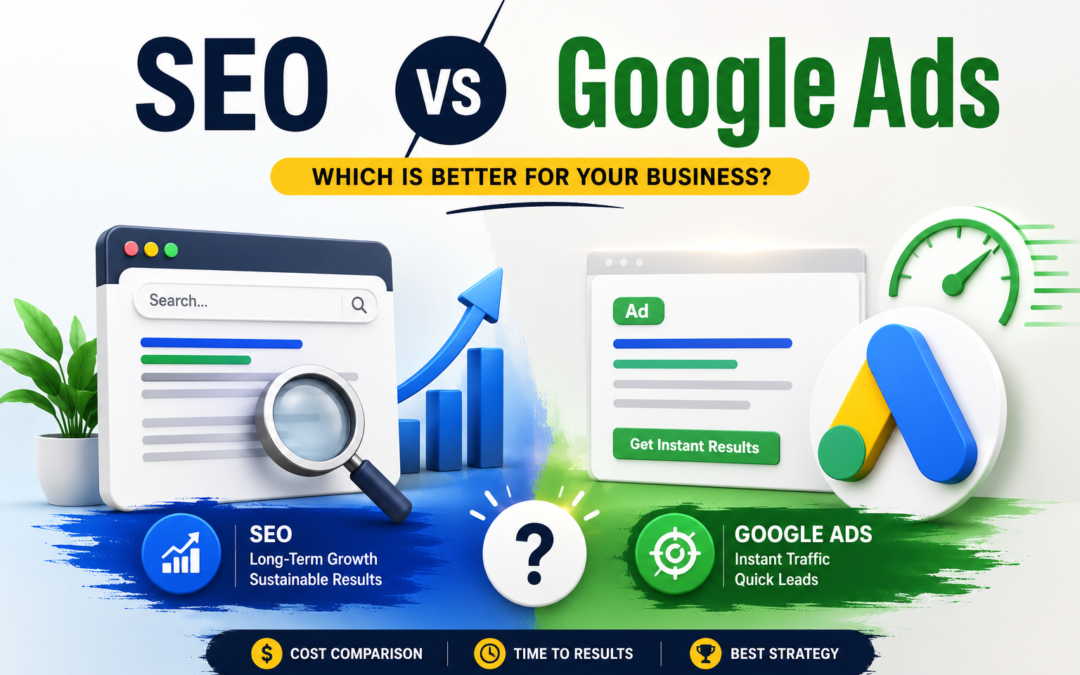
If you want the short answer, here it is: Google Ads is better when you need traffic, leads, or sales quickly. SEO is better when you want long-term growth, lower cost per lead over time, and stronger brand trust. Google Ads can put your business at the top of Google almost immediately, but you pay for every click. SEO takes longer, but once your pages rank well, they can keep bringing traffic without paying for each visit. For most businesses, the best choice is not SEO or Google Ads. It is knowing when to use each one and how to combine them based on your budget, timeline, competition, and goals.
Introduction
If you run a business, you have probably asked this question before:
Should I invest in SEO or Google Ads?
It is one of the most common marketing questions business owners ask. And it makes sense. Both channels can help you show up on Google. Both can bring traffic to your website. Both can generate leads and sales. But they work in very different ways.
That is why the SEO vs Google Ads debate can feel confusing.
One option helps you build free organic traffic over time. The other helps you pay for instant visibility. One is a long game. The other can work fast. One keeps bringing visitors after the work is done. The other stops the moment your budget runs out.
So which one is better?
The honest answer is simple: it depends on your business stage, budget, goals, and how fast you need results.
In this guide, you will learn:
- The real difference between SEO and Google Ads
- How both channels work
- The pros and cons of SEO
- The pros and cons of Google Ads
- Google Ads vs SEO cost comparison
- Which one is better for small businesses
- When to choose SEO
- When to choose Google Ads
- When to use both together
- A practical framework to make the right decision for your business
By the end, you will know exactly where to put your money, time, and effort.
What Is SEO?
SEO stands for Search Engine Optimization. In the comparison as SEO vs Google Ads, let’s learn about SEO first,
It is the process of improving your website so that it appears higher in the organic search results on Google and other search engines. Organic results are the unpaid listings you see below sponsored ads.
For example, if someone searches:
- “best digital marketing agency”
- “how to fix a leaking tap”
- “accounting software for small business”
- “wedding planner near me”
Google shows a mix of ads, maps, and organic results. SEO helps your website rank in those organic results.
What does SEO include?
SEO is not just about adding keywords to a page. Good SEO includes several parts:
1. Keyword research
This means finding the exact words and phrases your target audience searches on Google.
Examples:
- SEO vs Google Ads
- best SEO company for small business
- Google Ads management service
- digital marketing agency in Ahmedabad
2. On-page SEO
This includes optimizing the content and structure of your pages:
- Title tags
- Meta descriptions
- Headings
- URL structure
- Internal links
- Image alt text
- Keyword placement
- Helpful content
3. Technical SEO
This helps search engines crawl and understand your website. It includes:
- Site speed
- Mobile friendliness
- Secure HTTPS
- Clean site architecture
- Indexing and crawlability
- Structured data
4. Content creation
SEO works best when you publish useful content that answers real questions. This can include:
- Blog posts
- Service pages
- Landing pages
- Guides
- Comparison articles
- FAQs
5. Off-page SEO
This is about building your website’s trust and authority through:
- Backlinks from other websites
- Brand mentions
- PR coverage
- Local citations
- Reviews
How SEO works in simple words
Think of SEO like building a shop on a busy street.
You choose the right location, make the shop easy to enter, put useful products on the shelves, and earn a good reputation in the neighborhood. Over time, more people start visiting because your shop becomes known and trusted.
That is what SEO does for your website.
It helps Google understand:
- what your page is about,
- who it is useful for,
- and whether it deserves to rank for a search query.
What Is Google Ads?
Google Ads is Google’s paid advertising platform.
It lets you show ads on Google search results, YouTube, Google Maps, Gmail, and millions of websites in the Google Display Network. In the SEO vs Google Ads comparison, the most relevant part is Google Search Ads.
These are the sponsored results that appear at the top of Google when someone searches for something.
For example, if someone searches:
- “emergency plumber near me”
- “buy office chairs online”
- “digital marketing course”
- “best tax consultant in Ahmedabad”
Google may show ads above the organic results. Businesses pay to appear there.
How Google Ads works
Google Ads usually works on a pay-per-click (PPC) model. That means you pay when someone clicks your ad.
You choose:
- the keywords you want to target
- the location you want to target
- your daily budget
- your ad copy
- the page where people land after clicking
Then Google runs an auction whenever someone searches. Your ad position depends on things like:
- your bid
- ad relevance
- landing page quality
- expected click-through rate
Types of Google Ads for SEO vs Google Ads
Google Ads includes different campaign types, such as:
1. Search Ads
Text ads that appear on Google search results.
2. Display Ads
Banner ads shown on websites and apps.
3. Shopping Ads
Product ads with images and prices, mostly for eCommerce.
4. Video Ads
Ads on YouTube.
5. Performance Max
Automated campaigns that run across multiple Google properties.
For this article, when we say Google Ads, we are mainly talking about Search Ads, because that is what businesses usually compare with SEO.
SEO vs Google Ads: The Core Difference
The biggest difference between SEO and Google Ads is simple:
- SEO helps you earn unpaid traffic over time
- Google Ads helps you buy visibility instantly
That sounds basic, but it changes everything about cost, speed, strategy, and long-term results.
Here is a simple comparison.
SEO vs Google Ads comparison table
| Factor | SEO | Google Ads |
|---|---|---|
| Traffic source | Organic / unpaid clicks | Paid clicks |
| Speed of results | Slow to medium | Fast |
| Cost model | Investment in content, SEO work, tools, links, optimization | Pay per click or pay per impression |
| Time to see results | Usually months | Often same day or within days |
| Long-term value | High | Low if ads stop |
| Trust factor | Often stronger because users trust organic results | Good for visibility but some users skip ads |
| Scalability | Grows over time if done well | Scales with budget |
| Control | Less immediate control over rankings | High control over keywords, budget, targeting |
| Testing | Slower | Faster |
| Sustainability | Strong | Stops when budget stops |
| Best for | Long-term growth, authority, compounding traffic | Quick leads, launch campaigns, promotions, testing |
If you only remember one thing from this article, remember this:
SEO is an asset. Google Ads is a rented channel.
SEO takes time to build, but it can keep paying off for months or years. Google Ads can produce results fast, but the traffic usually disappears when you stop paying.
SEO vs Google Ads: How User Behavior Changes the Decision
Before choosing one channel, you need to understand how people search.
Not every search is the same. Some people are researching. Some are comparing. Some are ready to buy right now.
Searches with high buying intent
These searches often work very well for Google Ads:
- “buy CRM software”
- “emergency AC repair near me”
- “divorce lawyer consultation”
- “best dentist appointment today”
Why? Because the person is often ready to act now. Paid search can put your business in front of them at the exact moment they are looking.
Searches with research intent
These searches often work very well for SEO:
- “what is CRM software”
- “how to choose a digital marketing agency”
- “SEO vs Google Ads”
- “how much does kitchen renovation cost”
Why? Because people want information, not just a quick sale. Strong blog content and landing pages can attract them organically and move them toward a decision.
Searches with local intent
These can work well for both:
- “best bakery near me”
- “dentist in Ahmedabad”
- “digital marketing company near me”
If you need leads fast, Google Ads can help. If you want to dominate local search over time, SEO and local SEO are very powerful.
Benefits of SEO for Business Growth
SEO is often one of the best long-term investments a business can make. But it only works if you understand what it is good at.
1. SEO builds long-term traffic
This is the biggest reason businesses invest in SEO.
If a blog post or service page ranks well, it can bring traffic for months or even years. You do not pay for each click. That means the return can keep improving over time.
For example, imagine you publish a great page targeting:
“best accounting software for freelancers”
If it ranks on page one, it may bring traffic every month without you paying for every visit.
That is very different from Google Ads.
2. SEO can lower customer acquisition cost over time
SEO is not free. You may spend money on:
- content writing
- SEO tools
- technical fixes
- backlinks
- consultants or agencies
But once your pages start ranking, the cost per click becomes effectively lower than paid ads, because you are not charged every time someone visits your site.
That is why SEO often wins the long-term ROI battle.
3. SEO builds trust and credibility
Many users trust organic results more than ads. When your business appears naturally in search results, it can feel more credible.
This is especially true for:
- B2B services
- healthcare
- education
- finance
- software
- professional services
If your content is useful, detailed, and well-optimized, it helps build authority before the person even contacts you.
4. SEO supports the full buyer journey
SEO is not only for “buy now” searches.
It can target users at every stage:
- Awareness: “what is local SEO”
- Consideration: “best SEO tools for small business”
- Decision: “SEO agency pricing”
This helps you bring in visitors before they are ready to buy, educate them, and stay visible until they make a decision.
5. SEO improves your entire website
Good SEO is not just about rankings. It often improves:
- website structure
- content quality
- page speed
- mobile experience
- internal linking
- conversion paths
That means even users who come from ads, social media, or direct traffic benefit from the improvements.
6. SEO can support AI search visibility too
Search is changing. People are no longer only clicking blue links. They are using AI overviews, voice search, and answer engines.
Strong SEO content can help your brand appear in:
- featured snippets
- AI summaries
- People Also Ask sections
- voice answers
- comparison content surfaced by AI tools
Well-structured content with clear answers, headings, examples, and FAQs is more likely to be understood by both search engines and AI systems.
Limitations of SEO
SEO is powerful, but it is not magic. It has real downsides too.
1. SEO takes time
This is the biggest challenge.
If your website is new, your industry is competitive, or your domain has little authority, SEO can take months before you see strong results.
Some businesses start seeing movement in 3 to 6 months. Others need longer.
If you need leads this week, SEO alone may not be enough.
2. SEO is not fully predictable
You can do everything right and still face:
- strong competitors
- algorithm changes
- ranking fluctuations
- slow indexing
- local market challenges
SEO is a smart investment, but it is not a switch you turn on for instant traffic.
3. SEO needs ongoing work
SEO is not “publish once and forget forever.”
You need to:
- update content
- fix technical issues
- build links
- improve UX
- track rankings and conversions
- create fresh pages
If you stop maintaining your site, competitors can overtake you.
4. SEO is harder in highly competitive industries
If you are in law, insurance, finance, SaaS, healthcare, or major eCommerce categories, SEO can be very competitive.
You may need:
- a bigger content budget
- stronger backlinks
- better UX
- more niche targeting
- more patience
Benefits of Google Ads for Business Growth
Now let’s look at the other side of the SEO vs Google Ads comparison.
Google Ads can be extremely effective when speed matters.
1. Google Ads can generate traffic fast
This is the biggest advantage.
You can launch a campaign today and start getting clicks the same day. That makes Google Ads useful when you:
- launch a new product
- need leads quickly
- run a seasonal offer
- want to test a new service
- have a sales target to hit fast
SEO cannot usually do that.
2. Google Ads gives you high targeting control
With Google Ads, you can choose:
- exact keywords
- match types
- location
- device
- schedule
- audience signals
- budget
That level of control is valuable. It lets you spend money only where you see the best opportunity.
For example, a dentist in Ahmedabad can show ads only to people searching within a specific radius. A B2B SaaS company can bid only on high-intent software keywords.
3. Google Ads is great for testing
Google Ads can teach you a lot very quickly.
You can test:
- which keywords convert
- which headlines get clicks
- which landing page performs better
- which offer gets leads
- which location converts best
This makes Google Ads a strong research tool, not just a lead generation channel.
In fact, one smart strategy is to use Google Ads to learn what converts, then build your SEO content around those winning keywords.
4. Google Ads works well for high-intent searches
If someone searches:
- “book AC repair today”
- “buy payroll software”
- “wedding photographer price quote”
- “SEO agency for ecommerce”
they may be ready to take action now. Search ads can put you in front of that demand immediately.
5. Google Ads can be easier to measure in the short term
With proper tracking, you can see:
- impressions
- clicks
- click-through rate
- cost per click
- conversions
- cost per lead
- return on ad spend
That makes it easier to judge short-term performance.
Limitations of Google Ads
Google Ads is powerful, but it comes with trade-offs.
1. You pay for every click
This is the biggest downside.
Even if someone clicks and does not buy, you still pay.
In competitive industries, clicks can be expensive. If your landing page, offer, or sales process is weak, the budget can disappear fast.
2. Traffic stops when your budget stops
This is the biggest difference between SEO vs Google Ads.
With SEO, a strong page can keep bringing traffic after the work is done. With Google Ads, once you stop paying, visibility usually stops too.
That means Google Ads is not really building an owned traffic asset in the same way SEO does.
3. Google Ads can get expensive quickly
If you target broad, competitive keywords, you may face:
- high CPCs
- wasted clicks
- low conversion rates
- poor quality leads
Without proper account setup, negative keywords, strong landing pages, and conversion tracking, Google Ads can burn money fast.
4. Success depends heavily on landing page quality
Running ads to a weak page is like pouring water into a bucket with holes.
Even if the ad gets clicks, you may not get results if:
- the page loads slowly
- the offer is unclear
- the CTA is weak
- the page does not match search intent
- the form is too long
- the trust signals are missing
5. Some users skip ads
Not everyone clicks ads. Some users go straight to the organic results because they trust them more or simply ignore sponsored listings.
Google Ads vs SEO Cost: Which One Is More Affordable?
This is where many business owners get stuck.
They ask:
What costs more, SEO or Google Ads?
The short answer is:
- Google Ads usually costs more in the short term on a per-click basis
- SEO usually costs more upfront in time and effort
- SEO often becomes cheaper over time if it works
- Google Ads can be easier to start with a small test budget
Let’s break it down.
SEO costs
SEO costs may include:
- keyword research
- content writing
- technical SEO work
- page optimization
- link building
- local SEO setup
- tools
- agency or consultant fees
SEO is usually paid as:
- monthly retainer
- one-time project
- in-house salary cost
- content production budget
There is no cost per click, but there is a real cost to creating and maintaining the work.
Google Ads costs
Google Ads costs usually include:
- ad spend
- campaign management
- landing page creation
- conversion tracking setup
- creative testing
- reporting
You pay based on clicks or impressions, depending on the campaign type. Search campaigns are often click-based.
The real cost difference
Here is the simplest way to think about Google Ads vs SEO cost:
SEO cost profile
- Slower payoff
- Upfront effort
- No charge per click
- Better compounding return if rankings stick
Google Ads cost profile
- Faster payoff
- Ongoing spend
- Charge per click
- Easier to scale up or pause
Example: simple cost scenario
Imagine a small business sells a service worth ₹15,000 per customer.
Option 1: Google Ads
- Monthly ad budget: ₹50,000
- Management cost: ₹15,000
- Total monthly spend: ₹65,000
- Leads this month: 40
- Customers closed: 5
- Revenue: ₹75,000
This can work, but if you stop paying next month, the leads stop too.
Option 2: SEO
- Monthly SEO spend: ₹45,000
- Results are slow for 3 to 5 months
- Month 6 onward, organic traffic grows
- Leads from old blog posts and service pages continue
- Cost per lead may drop over time
In the beginning, Google Ads may feel better because it produces results faster. But after 6 to 12 months, SEO can become more efficient if the content ranks well and converts.
So which is cheaper?
If your question is:
“What is cheaper this month?”
The answer may be SEO if you do it in-house, or Google Ads if you run a very small ad test.
If your question is:
“What can produce leads faster?”
The answer is Google Ads.
If your question is:
“What usually gives lower cost per lead over the long term?”
The answer is often SEO, if your strategy is strong and you give it enough time.
SEO vs Google Ads for Small Business
Now let’s focus on the keyword SEO vs Google Ads for small business, because the answer changes depending on business size and cash flow.
Small businesses usually have:
- limited budget
- limited time
- fewer marketing resources
- strong pressure to generate leads quickly
That changes the decision.
When Google Ads may be better for a small business
Google Ads can be the better first move if:
- you need leads now
- your service has high buying intent
- you know what your customer searches for
- you already have a good landing page
- your average order value or lifetime value is high enough
- you can afford testing budget
Examples:
- emergency plumber
- dentist
- lawyer
- home renovation contractor
- local repair business
- high-ticket B2B service
These businesses often benefit from fast visibility on transactional searches.
When SEO may be better for a small business
SEO can be the better first move if:
- your ad budget is very limited
- you are willing to invest time instead of only money
- you want long-term growth
- your customers do research before buying
- you can publish useful content regularly
- your niche has strong local or informational search demand
Examples:
- coaching business
- digital marketing agency
- local bakery
- SaaS blog strategy
- interior design business
- education or training website
The best answer for many small businesses
For many small businesses, the smartest answer is not to choose one forever.
It is to use them in stages.
Stage 1: Use Google Ads to get immediate leads and test intent
Run a focused campaign on your highest-intent keywords.
Stage 2: Build SEO around the keywords, pages, and offers that convert
Create service pages, local landing pages, comparison pages, and blogs.
Stage 3: Reduce dependence on ads over time
As SEO starts bringing traffic, you can lower your paid dependency or use ads only for high-value campaigns.
This approach often gives the best balance of:
- short-term cash flow
- long-term visibility
- lower acquisition cost over time
When SEO Is Better Than Google Ads
Choose SEO first if these points describe your business:
1. You want long-term, compounding traffic
You want your content and pages to keep bringing visitors over time.
2. You have time to wait for results
You do not need all your leads immediately.
3. Your audience researches before buying
They compare options, read guides, and look for education.
You want people to see your business as trusted and knowledgeable.
5. You create content well
You can publish pages and blog posts that genuinely help users.
6. You want to reduce paid ad dependency in the future
You do not want your growth to depend only on ad spend.
When Google Ads Is Better Than SEO
Choose Google Ads first if these points describe your business:
1. You need leads or sales quickly
You have a revenue goal, a launch, or a seasonal campaign.
2. Your service solves an urgent problem
Emergency services, repairs, legal help, and time-sensitive needs often work well in paid search.
3. You want to test an offer fast
You are not sure which message, service, or keyword converts best.
4. Your website is new and SEO will take time
Ads can help you get traffic while your SEO foundation grows.
5. Your margins support paid acquisition
You can afford the cost per click and still stay profitable.
6. You have a strong landing page and follow-up system
Ads work best when your funnel is ready.
When You Should Use SEO and Google Ads Together
This is where many businesses get the best results.
Instead of asking SEO vs Google Ads, ask:
How can SEO and Google Ads support each other?
1. Use Google Ads for immediate traffic while SEO grows
This is one of the best combinations for a new website or a growing business.
- Ads bring traffic now
- SEO builds traffic for later
2. Use ad data to improve SEO
Ads can show you:
- which keywords get clicks
- which keywords convert
- which headlines work
- which landing page message performs best
Then you can use those insights to create better SEO content.
3. Use SEO content to support remarketing and brand trust
Someone may first find you through a paid ad, then visit your blog, read your case studies, and convert later.
That means SEO can improve the performance of paid traffic too.
4. Dominate more space on the search results page
If you rank organically and run ads too, you can own more screen space on Google for important searches.
That can increase visibility, clicks, and trust.
5. Protect your business from channel risk
If you depend only on ads, rising CPCs can hurt you. If you depend only on SEO, algorithm changes can hurt you.
Using both gives you a more stable growth system.
A Practical Decision Framework: Should You Choose SEO or Google Ads?
If you are still unsure, use this simple framework.
Choose SEO if:
- You want long-term growth
- You can wait 3 to 6+ months
- You want to build trust and authority
- You have content opportunities
- You want lower cost per lead over time
- You want traffic that does not stop when ad spend stops
Choose Google Ads if:
- You need leads now
- You want to test quickly
- You sell a high-intent service or product
- You have budget for paid traffic
- You already have a good conversion funnel
- You need immediate visibility
Choose both if:
- You want short-term and long-term growth
- You have some budget and some patience
- You want to learn what converts fast and then scale sustainably
- You are serious about search as a major customer acquisition channel
SEO vs Google Ads by Business Type
Different businesses often need different answers.
Local service business
Examples:
- dentist
- plumber
- electrician
- cleaning company
- salon
- contractor
Best approach: Google Ads + local SEO
Why: urgent searches and local intent are strong. Ads can bring fast leads. Local SEO can build long-term visibility in maps and organic results.
eCommerce business
Best approach: SEO + Shopping Ads / Search Ads
Why: ads can drive immediate product traffic. SEO can bring category and blog traffic over time.
B2B service business
Examples:
- marketing agency
- software consultant
- IT service provider
- HR consultant
Best approach: Often both, with strong content SEO
Why: B2B buyers research a lot before choosing. SEO is powerful for trust and education. Ads can support bottom-funnel keywords.
New startup
Best approach: Google Ads first, SEO foundation in parallel
Why: startups usually need validation and traffic quickly. But they should still build SEO assets early.
Content-heavy business
Examples:
- blog, publisher, educational brand, course business
Best approach: SEO first
Why: content is a major growth engine and organic traffic can compound strongly.
Common Mistakes Businesses Make in the SEO vs Google Ads Decision
Mistake 1: Expecting SEO to work like ads
SEO is not instant. It needs patience, quality, and consistency.
Mistake 2: Running Google Ads without conversion tracking
If you do not know which keywords generate leads or sales, you are guessing.
Mistake 3: Sending ad traffic to a weak page
Even a great ad will fail if the landing page is poor.
Mistake 4: Choosing based only on cost, not profitability
A click may be expensive, but if it leads to a high-value customer, it can still be worth it.
Mistake 5: Ignoring search intent
The right channel depends on what the user wants when they search.
Mistake 6: Treating SEO and Google Ads as enemies
In many cases, they work better together than alone.
A Simple 90-Day Plan for Businesses That Want Both
If you want a practical starting point, here is a simple plan.
Month 1: Set the foundation
- Define your top services or products
- Identify high-intent keywords
- Set up conversion tracking
- fix core website issues
- create or improve key landing pages
- launch a small Google Ads campaign for your best keywords
Month 2: Build SEO assets
- publish 4 to 8 high-quality pages or blog posts
- optimize title tags, headings, and internal links
- create local pages if relevant
- improve page speed and mobile UX
- study ad keyword performance
Month 3: Connect the insights
- turn winning ad keywords into SEO content
- pause poor ad keywords
- improve landing pages based on ad data
- build backlinks or local citations
- add FAQs and schema where useful
By the end of 90 days, you should know:
- what people search for
- what converts
- which pages need improvement
- whether ads are profitable
- where SEO can compound
Final Verdict: SEO vs Google Ads — Which Is Better for Your Business?
So, SEO vs Google Ads: which is better for your business?
Here is the final answer.
Choose SEO if:
You want long-term growth, compounding traffic, stronger trust, and lower acquisition costs over time.
Choose Google Ads if:
You want immediate visibility, faster leads, quick testing, and more control over targeting and budget.
Choose both if:
You want the strongest overall strategy.
For most businesses, especially small and growing businesses, the smartest approach is this:
- Use Google Ads for short-term speed
- Use SEO for long-term stability
- Use data from each channel to improve the other
That way, you are not just buying traffic. You are also building a lasting search presence.
In other words, stop thinking only in terms of SEO vs Google Ads.
Start thinking in terms of timeline, intent, cost, and growth stage.
Because the right answer is not the same for every business.
The right answer is the one that fits your goals, your cash flow, your market, and your customer journey.
FAQs: SEO vs Google Ads
Is SEO better than Google Ads?
SEO is better for long-term traffic, trust, and lower cost per click over time. Google Ads is better for immediate visibility and faster lead generation. The better option depends on your timeline, budget, and business goals.
What is the difference between SEO and Google Ads?
SEO helps your website rank in unpaid organic search results, while Google Ads lets you pay to appear in sponsored search results. SEO takes longer but can deliver long-term traffic. Google Ads is faster but traffic usually stops when you stop paying.
Which is better for small business: SEO or Google Ads?
For small businesses, Google Ads can be better if you need leads quickly. SEO can be better if you want long-term growth and cannot rely on paid traffic forever. In many cases, a small business should use both in stages.
Is SEO cheaper than Google Ads?
SEO often becomes cheaper over time because you do not pay for each click. But it still requires investment in content, optimization, and maintenance. Google Ads can cost more month to month because every click has a price.
How long does SEO take compared to Google Ads?
Google Ads can start driving traffic within hours or days. SEO usually takes several months to build momentum, especially for new websites or competitive keywords.
Can I do SEO and Google Ads at the same time?
Yes, and in many cases you should. Google Ads can bring quick traffic and keyword data, while SEO builds long-term visibility and lowers dependency on paid traffic.
Does Google Ads help SEO directly?
Google Ads does not directly improve your organic rankings. However, it can help you test keywords, improve landing pages, and learn which search terms convert, which can strengthen your SEO strategy indirectly.
Should a new website start with SEO or Google Ads?
A new website often benefits from starting with a small Google Ads campaign for immediate traffic while building SEO in parallel. Ads can create quick visibility, while SEO builds long-term value.
Which has better ROI: SEO or Google Ads?
Google Ads often produces faster ROI if campaigns are well-managed and search intent is high. SEO often produces stronger long-term ROI because the traffic can keep coming without paying for each click.
Is Google Ads worth it for local businesses?
Yes, Google Ads can work very well for local businesses, especially when people search with strong intent such as “near me” or urgent service terms. But local SEO is also important for long-term visibility in organic search and map results.
Conclusion
If you came here looking for a simple winner in the SEO vs Google Ads debate, the answer is not one-size-fits-all.
Google Ads wins on speed. SEO wins on long-term value.
If you need leads this week, start with Google Ads.
If you want traffic that keeps growing over time, invest in SEO.
If you want the strongest business growth system, use both with a clear strategy.
The real goal is not to pick a side.
The real goal is to choose the channel mix that helps your business grow profitably.
And for most businesses, that means building a plan where SEO creates the foundation and Google Ads acts as the accelerator.